
The veterinary M&A market looks nothing like it did three years ago. Private equity buyers pulled back sharply after 2022, the industry has been sitting in what the AVMA’s chief economist has publicly called a recessionary stretch since late 2024, and yet well-run practices are still commanding strong multiples. If you’re trying to figure out what a practice is actually worth in 2026, whether you’re buying your first clinic or thinking about your own exit, the honest answer is: it depends enormously on which kind of practice you’re talking about.
Here’s what’s actually happening in the numbers, and what it means for you.
Key Takeaways
- Practice valuation multiples in 2026 range from roughly 4x to over 17x EBITDA, depending almost entirely on quality and scale.
- The large-platform PE buying spree has cooled since 2022, but well-run, “A+” hospitals are still commanding premium multiples.
- Clean financials and low doctor-dependency matter more to your multiple than almost anything else.
- If you’re buying, the multiple directly shapes how much you can responsibly finance through an SBA or conventional loan.
- If you’re selling, most advisors recommend a 12-36 month prep window, not a 6-month scramble.
Why Veterinary Practice Valuations Look Different in 2026
For most of the 2010s and early 2020s, the story around veterinary practice value was simple: corporate consolidators and private equity groups were paying aggressive multiples for almost anything with a pulse, and roll-ups made even mediocre practices attractive acquisition targets. That environment has shifted. Large-platform recapitalization activity has been largely dormant since a major 2022 transaction, and industry economists have described the sector as being in a genuine economic downturn dating back to around November 2024, with early signs of recovery not expected until roughly the second quarter of 2026.
The result is what several industry analysts are now calling a bifurcated market. Instead of a rising tide lifting every practice’s value, buyers are becoming far more selective — rewarding well-run, well-documented practices with strong multiples while pushing sub-scale or poorly-run practices toward the bottom of the range.
How a Veterinary Practice Is Actually Valued
Almost every serious valuation, whether it’s coming from a corporate buyer, a private equity-backed platform, or an independent buyer using SBA financing, starts with the same core method: a multiple of EBITDA (earnings before interest, taxes, depreciation, and amortization).
In practice, this means two things determine your number more than anything else:
- Your true, “adjusted” EBITDA — your actual profitability once you add back owner perks, above-market owner compensation, one-time expenses, and other non-recurring items that a new owner wouldn’t inherit.
- The multiple a buyer is willing to apply to that EBITDA, which is where quality, size, and risk come in.
A practice that looks profitable on paper but has messy books, inconsistent coding, or an owner who personally handles every complex case will get a lower multiple than an identical practice with clean financials and a team that can run without the owner in the room.
The 2026 Multiple Ranges, Tier by Tier
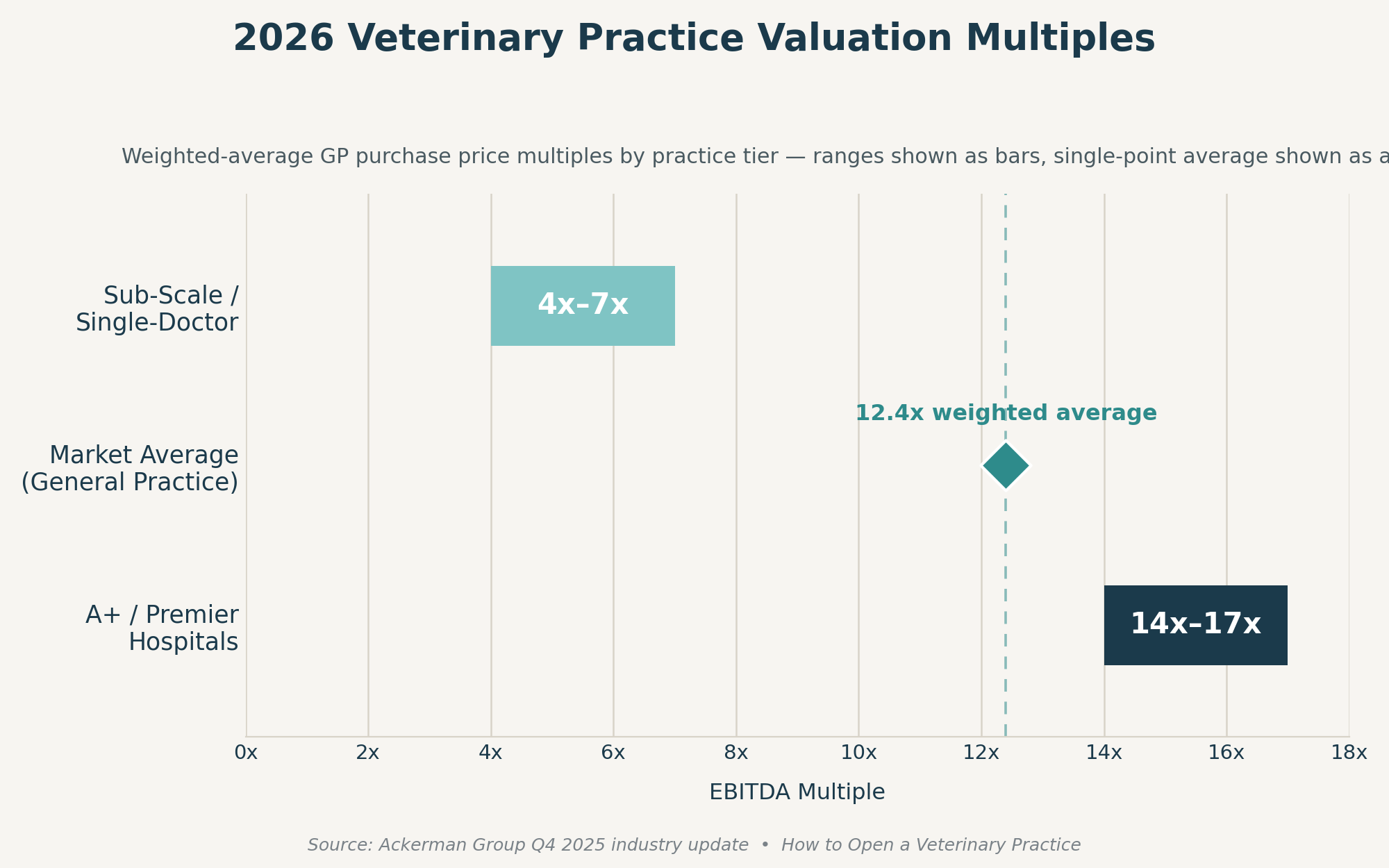
Based on late-2025 industry benchmarking from the Ackerman Group, here’s roughly where the market sits heading into 2026:
- Sub-scale, single-doctor, demand-limited practices: roughly 4x-7x EBITDA
- Market-average general practices: a weighted average around 12x EBITDA
- “A+” or premier multi-doctor hospitals: 14x and often higher
That’s close to a 4x spread between the bottom and top of the market, which means the difference between an average practice and a well-positioned one isn’t a rounding error. On a practice generating $400,000 in adjusted EBITDA, that’s the difference between a roughly $1.6 million valuation and a $5.6 million one.
Not sure where your practice or the practice you’re targeting actually falls on this range? That’s exactly the kind of question we walk through in a free consultation.
What Pushes a Practice From a 5x to a 12x+
The gap between tiers usually comes down to a handful of factors buyers scrutinize closely:
- Doctor dependency. Practices that depend entirely on one owner-veterinarian for revenue are riskier to a buyer than practices with associates who can carry the caseload.
- EBITDA margin, not just revenue. A smaller practice with strong margins often values better than a larger one with thin margins.
- Clean practice management software data. Buyers now run real IT and data diligence before closing. Duplicate client records, miscoded services, and inconsistent controlled-substance logging all get priced into an offer as risk.
- Facility and lease terms. A short remaining lease term or a facility needing near-term capital investment both weigh on value.
- Growth trend, not just current numbers. Buyers pay for a trajectory, not a snapshot.
- Compliance structure. In states with corporate practice of veterinary medicine (CPVM) restrictions, having your entity structure already set up correctly can materially speed up (or slow down) a deal.
If You’re Buying an Existing Practice
If you’re exploring buying rather than building from the ground up, the multiple you’re being asked to pay directly shapes your financing plan. A practice priced at a rich multiple needs to justify that price with real, defensible EBITDA and growth because your lender will be underwriting the deal on those same numbers. We’ve broken down how SBA and conventional financing options compare for practice purchases in Conventional Loans vs. SBA Loans: Which Is Best for Your Veterinary Practice? — worth reading before you make an offer, not after.
It’s also worth remembering that roughly eighteen states restrict non-veterinarian ownership of a practice, and corporate buyers typically work around this through a management services organization (MSO) paired with a veterinarian-owned professional entity. If you’re buying from a practice that was previously part of a corporate structure, expect extra time for regulatory and state board review before closing.
If You’re Weighing an Exit
If you’re the one considering a sale, the biggest mistake we see is starting the process six months before a target close date. Most advisors now recommend a 12- to 36-month runway to clean up financials, address doctor dependency, and fix the kind of data hygiene issues that get discovered and priced against you during diligence. Owners who rush this process typically leave a meaningful percentage of enterprise value on the table simply because they didn’t have time to fix fixable problems.
This is also worth weighing against the broader shift happening in the profession right now. If you’ve been considering whether corporate consolidation is actually the right fit for your practice’s next chapter versus staying independent, or exploring a roll-up with other local owners, our article on leaving corporate veterinary medicine is a useful companion read.
The Bottom Line
Valuation multiples in 2026 are wide and that’s actually good news if you’re willing to do the work. A 4x spread between the bottom and top of the market means the practices that invest in clean books, reduced doctor dependency, and a real growth story are being rewarded disproportionately for it, even in a cooler overall market. Whether you’re buying your first practice or planning your exit from one, the multiple isn’t just a number it’s a reflection of exactly how “buyer-ready” your practice actually is.
Frequently Asked Questions
What is a good multiple for a veterinary practice in 2026?
The market-wide weighted average is around 12x EBITDA, but the range runs from roughly 4x for sub-scale, single-doctor practices up to 14x-17x or higher for top-tier, multi-doctor hospitals with clean financials and low owner dependency.
How is EBITDA calculated for a veterinary practice?
Start with net profit, then add back interest, taxes, depreciation, and amortization, then further “normalize” it by adding back one-time expenses and above-market owner compensation to reflect what a new owner would actually take home.
Do independent practices sell for less than corporate-backed ones?
Not necessarily. Buyers price the practice’s financials, doctor-dependency, and data quality, not its ownership structure. A well-run independent practice can out-value a poorly-run practice inside a larger group.
Whether you’re evaluating a practice to buy or thinking about your own timeline to sell, getting a clear read on where you actually stand is the first step.Schedule a free consultation or download our free ownership playbook to get started.