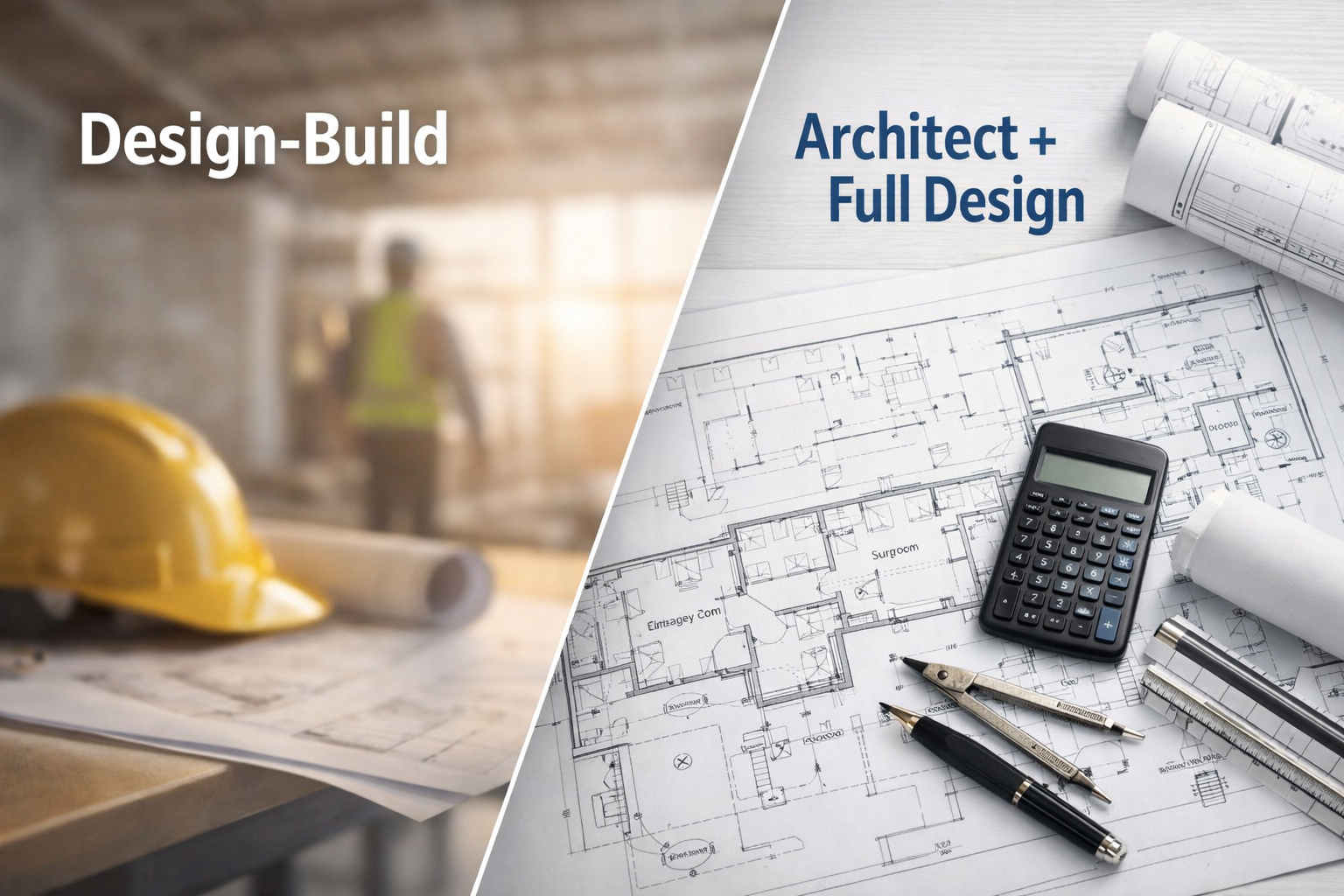
Design-Build is often marketed as the simplest, fastest, and most cost-effective way to open a veterinary practice.
And while it can work in certain situations, the idea that Design-Build should be the default solution is one that deserves closer examination, especially for veterinary practice owners trying to control costs and protect their investment.
The reality?
Design-Build often benefits the builder more than the owner.
Let’s break this down honestly.
Why the Industry Pushes Design-Build So Hard
Design-Build is attractive to construction companies for one main reason:
Control.
When a contractor controls both design and construction:
- They control the budget narrative
- They control pricing decisions
- They control scope interpretation
And once you sign a Design-Build contract, you’re locked in, often before your practice is fully designed or priced in detail.
From an owner’s perspective, that’s risky.
The Hidden Cost Risk of Design-Build
Design-Build is frequently sold as “cost certainty,” but here’s what that usually means in practice:
- The project is priced before the design is fully developed
- Many decisions are deferred until construction
- Those decisions are then priced by the contractor, not competitively
At that point:
- You can’t shop pricing
- You can’t rebid scope
- You can’t easily change teams
And because veterinary spaces are complex (surgery, imaging, dental, treatment, specialized HVAC, plumbing, and electrical) those deferred decisions can become very expensive later.
Why Starting with an Architect Is Often the Smarter Move
For most veterinary practices, the best way to control costs is not speed, it’s clarity.
Hiring an architect first and completing:
- Full architectural drawings
- MEP engineering (Mechanical, Electrical, Plumbing)
- A well-defined scope
does three critical things:
1. It Eliminates Guesswork
When everything is clearly designed, fewer decisions are left “to be figured out in the field” — where costs tend to escalate quickly.
2. It Protects You From Contractor Markups
When scope is vague, contractors price risk — and that risk often shows up as inflated numbers. Clear drawings reduce that buffer.
3. It Gives You Leverage
With a complete set of drawings:
- You can competitively bid the project
- You can compare apples to apples
- You’re not tied to a single builder
That leverage alone can save tens — sometimes hundreds — of thousands of dollars.
The Reality of Veterinary Practice Design
Veterinary practices are not standard tenant build-outs.
They involve:
- Specialized equipment loads
- Medical-grade plumbing and electrical
- Complex HVAC and air balance requirements
- Workflow-critical adjacencies
When these systems aren’t fully engineered upfront, costs don’t disappear — they just get pushed downstream to construction, where they’re harder to control.
When Design-Build Can Make Sense
This isn’t an anti–Design-Build argument — it’s a pro-owner one.
Design-Build can work when:
- The scope is very small or repetitive
- The building conditions are well known
- The owner fully understands what’s included (and what isn’t)
- The team has a proven track record in veterinary facilities
But it should be a deliberate choice, not the default.
A Better Question to Ask
Instead of asking:
“Should I do Design-Build or not?”
Ask:
“How do I keep control of my budget and decisions?”
For many veterinary practice owners, the answer is:
✔ Design first
✔ Engineer everything
✔ Define scope clearly
✔ Then bring construction pricing to the table
That sequence protects you, not the builder.
Final Takeaway
Design-Build isn’t inherently bad — but the way it’s commonly promoted can leave veterinary practice owners:
- Locked into contracts too early
- Exposed to price escalation
- Without true budget transparency
Starting with a fully designed and engineered set of drawings gives you clarity, control, and leverage — and in veterinary construction, those are far more valuable than speed alone.
The best projects aren’t rushed.
They’re planned.